
Takallam vs Ada
Ada is a mature chat automation platform: a no-code bot builder, a large library of integrations, and some of the best deflection analytics in the market, tuned over years of enterprise deployments. Takallam starts from a different centre — one AI agent that is voice-native across a QR scan, the phone, chat and email, built in the UAE with real Emirati and Gulf dialect. Both automate customer conversations. The difference is whether the centre of gravity is chat deflection at enterprise scale, or a single voice-first agent answering every channel for the Gulf.
Ada was built for chat at scale. Takallam speaks first.
Ada is very good at deflecting chat volume: a no-code builder for automated flows, deep integrations into the enterprise stack, and analytics that show exactly how much you deflected and where. Voice is a newer and secondary area for it, and there is no scan-to-speak QR channel. Takallam inverts the order — voice is the first-class channel, the same AI agent answers on a QR scan, the phone, in chat and over email, and a person is brought in on the same thread when the AI cannot finish it. If your problem is deflecting large chat volume across an enterprise, Ada fits that shape. If most of your conversations start with a voice and you want one agent across every channel, that is the job Takallam is built for.
- Ada is a mature enterprise chat automation platform with real depth in deflection. This page does not argue otherwise.
- Takallam is priced per interaction with published tiers, not enterprise seat licences or a quote you have to chase.
- The QR scan-to-speak voice channel has no equivalent in a chat-first platform: no widget to embed, no number to dial.
- If you need enterprise chat deflection, a large integration marketplace and analytics tuned over years, a chat-first platform is the right tool.
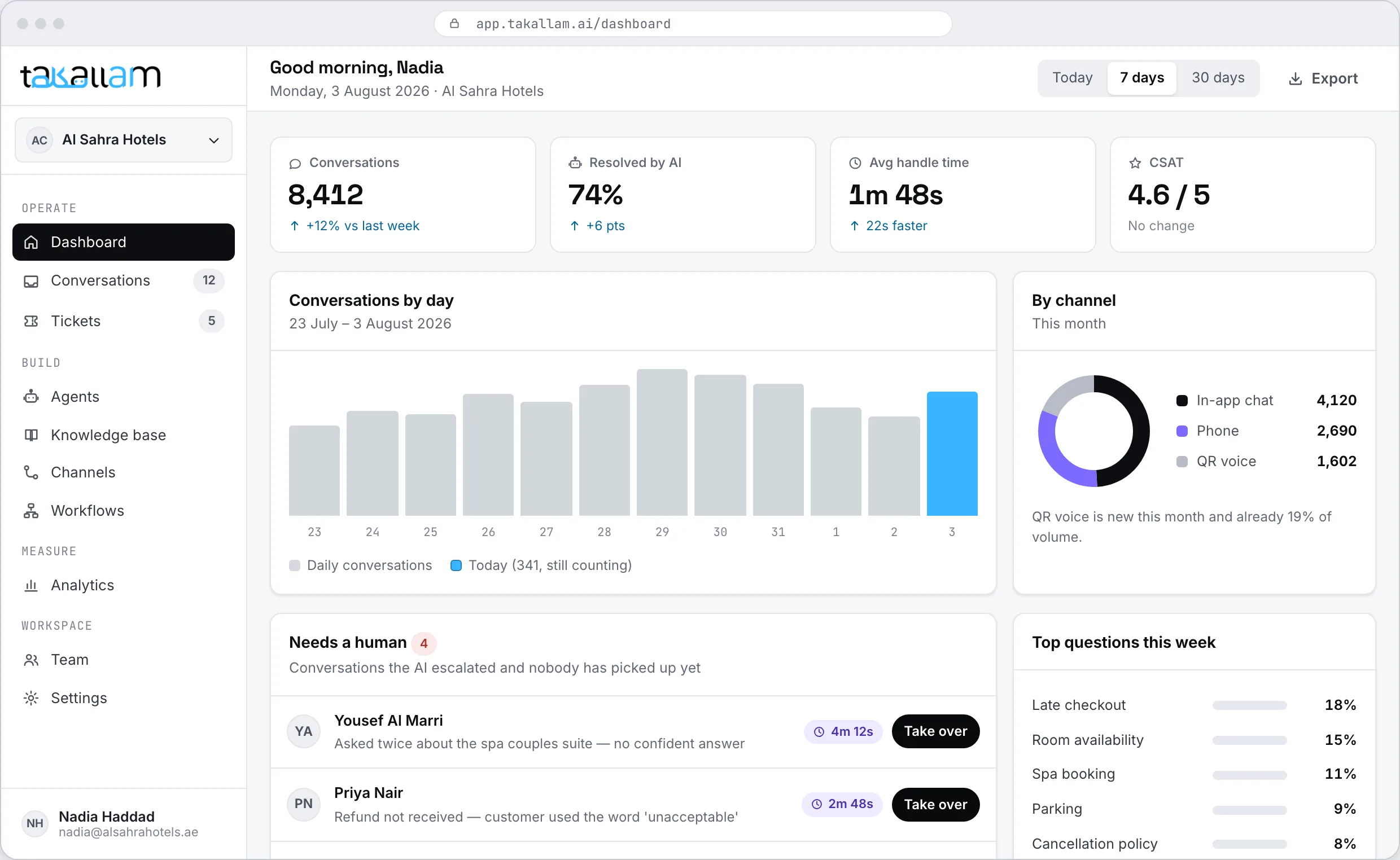
Three cases where the chat-first platform is the right call
Said plainly, because pretending otherwise would waste your time. If one of these is you, the chat-first platform is the better buy.
Enterprise chat automation at scale
Millions of chat sessions, mature flow tooling, and a no-code builder refined over years of large deployments. Ada is built to deflect chat volume at that scale, and it does it well.
A large integration ecosystem
A broad marketplace of connectors into CRMs, help desks and the wider enterprise stack. Takallam integrates around the conversation, but Ada has a deeper and longer catalogue of third-party integrations.
Deflection analytics you can trust
Reporting that shows exactly what was deflected, where flows drop off, and the ROI of automation, refined over many enterprise programmes. If deflection reporting is the core metric, Ada has more mileage there.
What each one ships with
Capability, not price. Both automate customer conversations and both are multilingual. The difference is the shape: chat deflection at enterprise scale, or one voice-native AI agent across every channel.
| Capability | Takallam | Ada |
|---|---|---|
| No-code chat automation builder | ||
| In-app and web chat | ||
| Large third-party integration library | Around the conversation | |
| Mature deflection analytics at scale | ||
| Enterprise chat automation at scale | ||
| Voice-native AI agent | Newer, secondary | |
| Inbound phone number and telephony | ||
| Scan-a-QR-code voice channel | ||
| Email answered from your support address | ||
| One AI agent across QR voice, chat, email and phone | ||
| Knowledge base built from your website | ||
| Human takeover in the same thread | ||
| Emirati and Gulf dialect voice | ||
| UAE data residency by default | ||
| Pricing model | Per interaction, published tiers | Enterprise seat / quote |
Capability comparison as of 2026, based on public documentation for each product. A half-mark means the capability exists in some form but is scoped differently — Ada around chat deflection at enterprise scale, Takallam around one voice-native agent per channel. Ada is a mature CX automation platform; the comparison is about product shape, not quality.
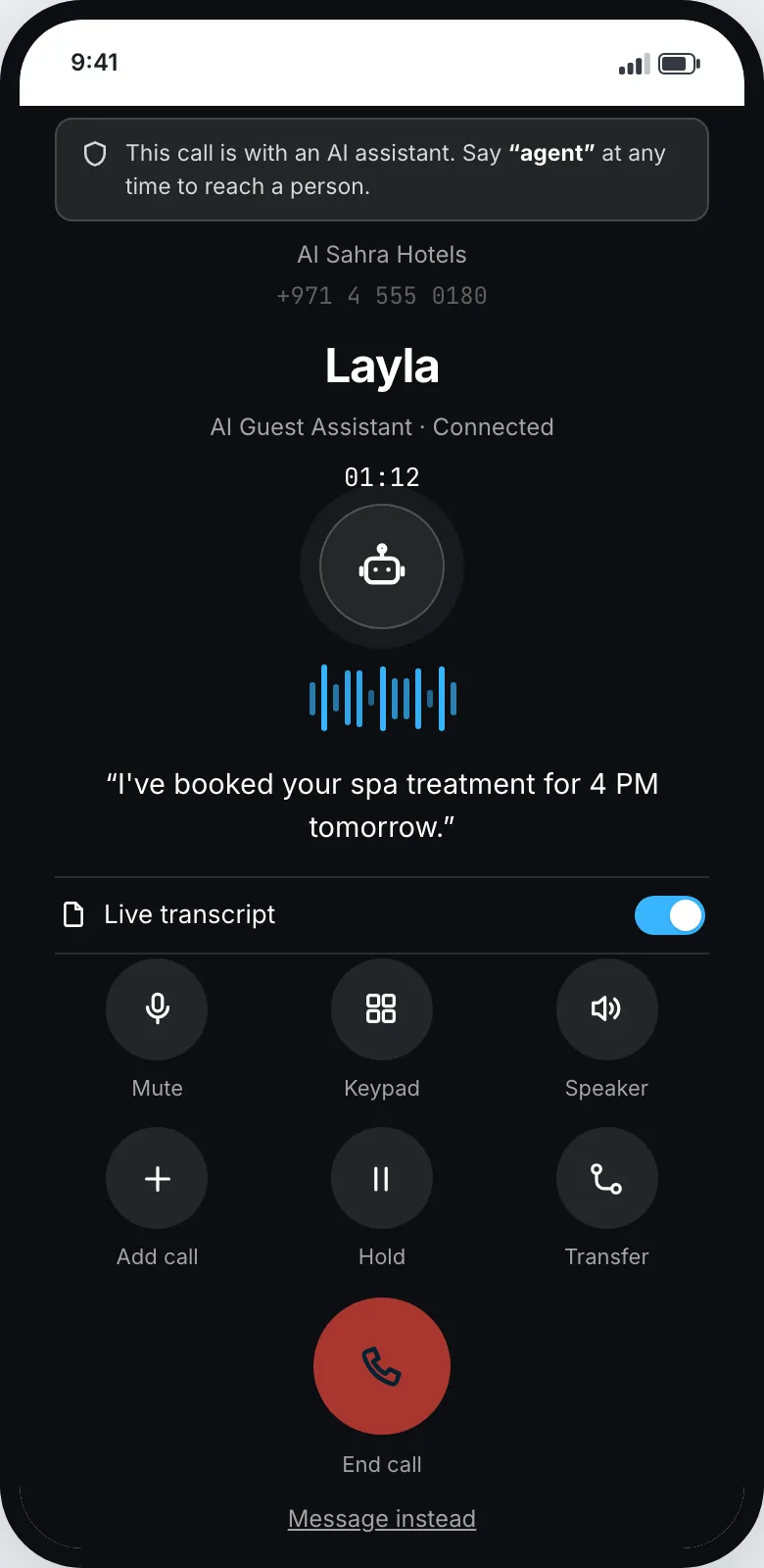
The question arrives at a door, not a chat widget.
A guest standing at a hotel room, a shopper at a shelf, a resident at a building entrance — the moment they have a question, they are not on your website and they do not want to type. Takallam prints a QR code they scan and speak to, opening a voice conversation in the browser with no app and no number. A chat-first platform is built for the message that arrives in the widget; this is the conversation that never becomes a chat at all.
- Scan-to-speak voice on a printed code — on a door, a shelf, a delivery box or a table.
- No app to download, no number to dial, no chat window to find — the conversation opens instantly.
- The same agent, knowledge base and record as the phone, chat and email channels.
- Right-to-left and Emirati dialect across the whole scan-to-speak experience.
Both are multilingual. One was built to speak Emirati.
Ada supports many languages and does it competently across chat. Takallam goes one level deeper on the language itself: Emirati and wider Gulf dialect in voice and text, code-switching mid-sentence between Arabic and English, and the same register carried across the QR code, chat, email and phone rather than translated into a chat flow. In the Gulf, how the answer sounds is part of whether it lands, and that is hard to reach with a globally tuned chat model.
- Emirati and Gulf dialect in voice and in text, not only Modern Standard Arabic or a global translation.
- Code-switching treated as normal conversation rather than a parsing failure.
- The same dialect and register across all four channels, not just the chat window.
- Data resident in the UAE region by default, with retention you control.
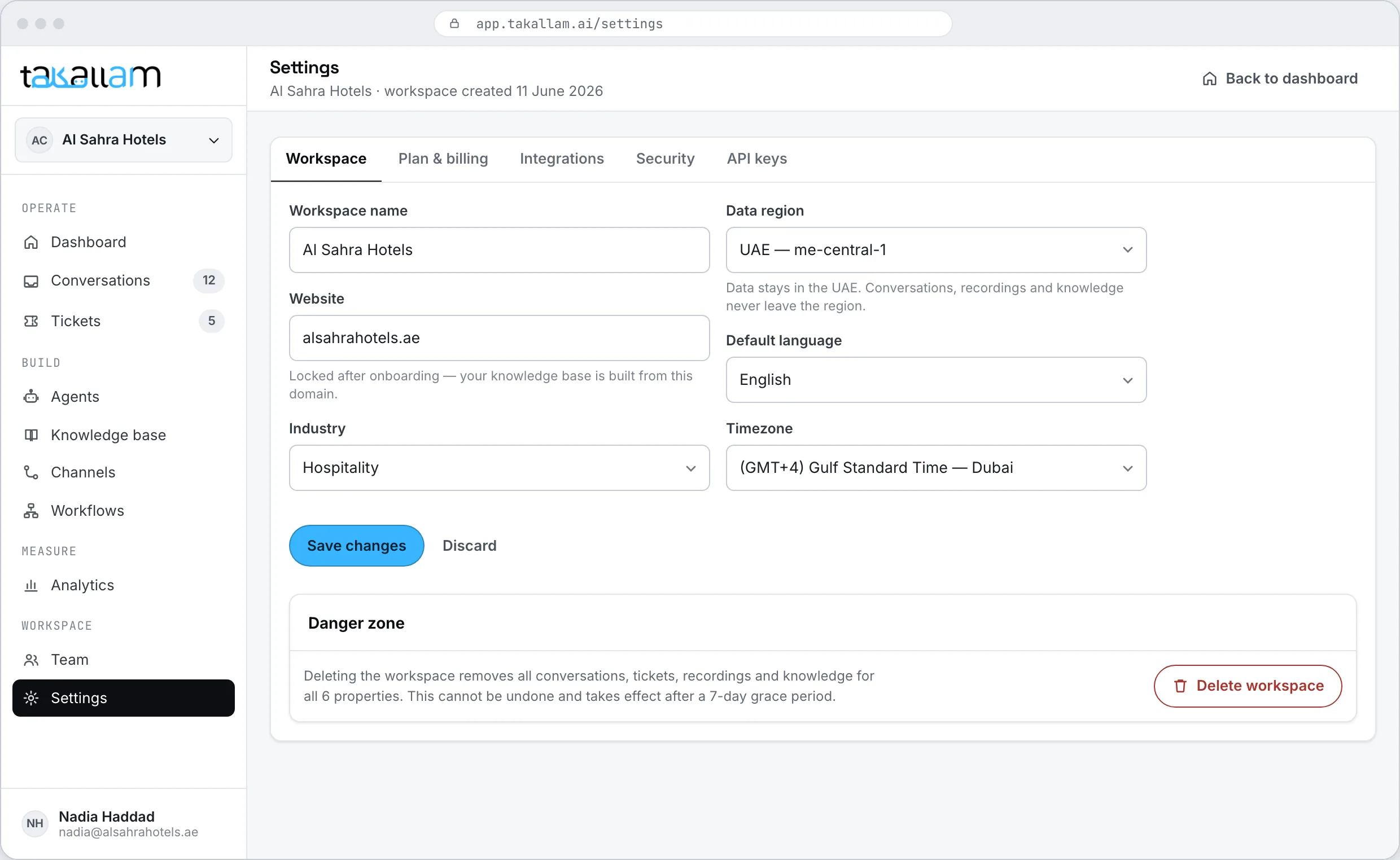
What sits behind the conversation
None of this is an integration you go and buy. It is the product.
Knowledge base from your site
Takallam crawls your website, pulls in your policies, rates and FAQs and shows you what it learned. You remove what it should not use and add documents of your own.
See the knowledge baseOne inbox for four channels
QR voice, chat, email and phone conversations in a single queue, assignable to people, with the history of the customer attached rather than searched for.
See the inboxHuman takeover in the thread
Low confidence, an angry tone, a request the agent is not allowed to fulfil. Your team continues the same conversation instead of starting a new one.
See handoverTickets and SLAs
For the things that genuinely need tracking: owners, priorities, due times and a queue that shows what is about to breach.
See ticketsWorkflows around the conversation
When a conversation ends, summarise it, branch on what changed, update the system that owns the record and message the customer. Built by dragging blocks.
See the workflow builderThe channel that has no widget
A printed code on a door, a shelf or a delivery box that the customer scans and speaks to. No app, no download, nothing to dial or type.
See the QR channelChoosing between them
Is Takallam a replacement for Ada?
It depends on the job. If your goal is to deflect large chat volume across an enterprise with a mature no-code builder, a big integration marketplace and deep deflection analytics, Ada is built for that and Takallam is not trying to be. If your goal is one voice-native AI agent across QR voice, chat, email and phone — built for the Gulf, with people stepping in only when needed — that is what Takallam does.
Ada is a mature platform — what is the real difference?
Maturity is not the argument. Ada is a chat-first automation platform organised around deflection at enterprise scale, with voice as a newer and secondary area. Takallam is a voice-native agent organised around channels, built in the UAE, with a QR scan-to-speak channel Ada does not have. One is built to deflect chat at scale; the other is built to answer in a voice, on every channel, for the Gulf.
Can Ada do QR scan-to-speak?
A chat-first platform is built around the message that arrives in the widget, so scan-to-speak voice is not part of that shape, and voice generally is a newer area for it. In Takallam a printed code opens straight into a voice conversation in the browser — no number, no app, no widget — and it is the channel the product was designed around.
Which one handles Emirati Arabic better?
Ada is multilingual and handles Arabic competently in chat. Takallam goes deeper on the dialect itself: Emirati and Gulf speech in voice and text, code-switching inside a sentence, and the same register across every channel rather than a globally tuned chat flow. If the way the answer sounds matters, that is where Takallam was focused.
We already have Ada. Can we run Takallam alongside it?
Yes. You can keep Ada on your chat volume and start Takallam with the QR voice, phone and email channels, then compare on your own volume. Takallam builds its knowledge base from your website automatically, so there is nothing to migrate by hand to trial it.
How is Takallam priced against an enterprise platform?
Takallam bills per interaction with published tiers in AED and prices each channel separately, with no per-seat licences and no minimum commitment. Enterprise platforms typically price on seats or an annual quote you have to negotiate. Rates are being set with the first cohort — join the waitlist and we will quote against your real volume.
Deflecting chat at scale, or answering in a voice on every channel?
Tell us how your customers reach you and how much of it starts with a voice. If you need enterprise chat deflection, we will tell you. If most of it can be answered by one voice-native agent, we will show you what going live looks like.
Pay per interaction · published tiers · no seats, no minimums